
This entire site only takes about 20 minutes to read, so it’s highly recommended you go through it all for the greatest understanding.
Skip the Intro, Start Reading It. Or…
Continue to the introduction below and understand what spam is, who sends it, how they got your email address in the first place, how to keep your address more secure because you cannot “unsubscribe” from their junk (but we’ll tell you how to tell when you can), and why anti-spam laws don’t help.
So, you’re stuck with it? No: I’ll tell you how to filter your email to reduce the spam you get, and the flip side: how legitimate mail (to you and from you) gets caught in spam filters and how to improve the odds that your mail gets delivered. I wrap up with the hugely important concept of “phishing” and other scams that can literally result in your bank account being drained by criminals, how you may be an unwitting part of the spam problem, and a little about urban legends and chain mails. That’s a lot, but you really can get it all read in just 20 minutes.
Or! An alternative to reading this site: the information on this site plus much more has been published as an ebook, and is available on Kindle (including the free Kindle apps for your smartphone or computer, if you don’t have a Kindle device) for just $4. Includes full details on how I solved his spam problem (I only get 2-4 in my inbox per week out of the thousands sent, plus answers to questions from this site’s readers, and more. Click on the cover to order from Amazon.com, or click for the Amazon store you use: Amazon USA | Amazon France | Amazon UK | Amazon Germany | Amazon Italy | Amazon Spain.
Introduction
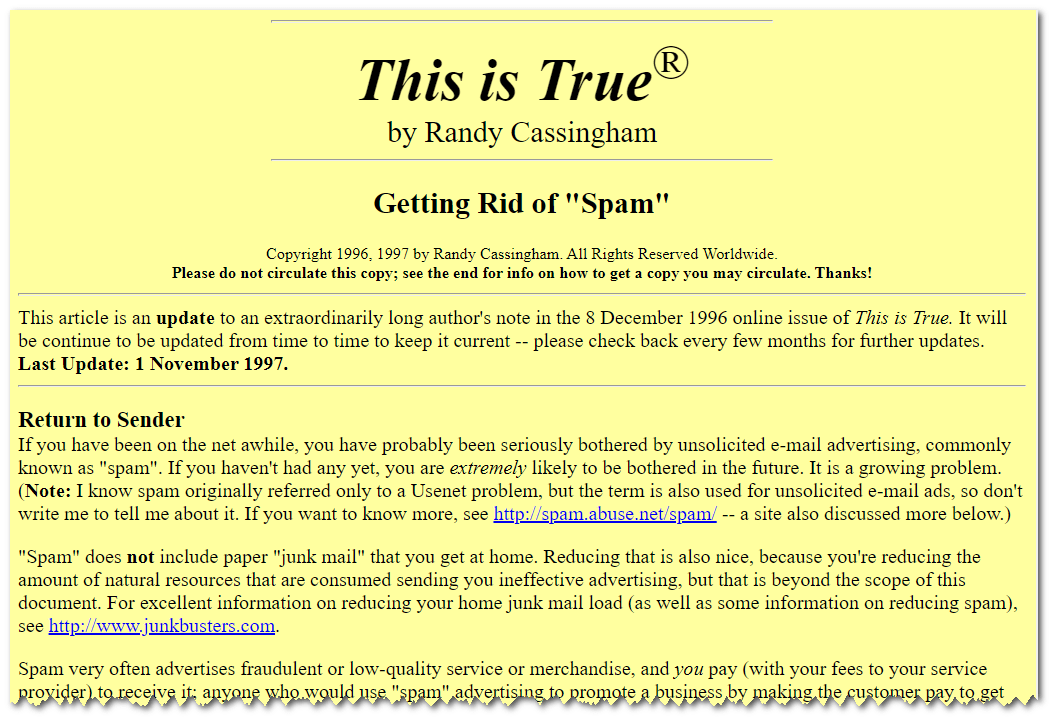
The Spam Primer started in 1996 as a way to help people deal with a then-new problem: spam. Even then, as an online publishing pioneer I realized spam would become a huge problem for everyone who depends on email (and it has: it’s estimated that about 90 percent of all email traffic is spam, which makes it difficult for legitimate email to get through, and to find it among all the garbage!)
Spam has of course grown to be more than a nuisance: you can have your identity stolen and see all of your bank accounts drained. And that can easily happen! Take your time on this site and explore the various topics and concepts to make sure you understand them all. Each page is an easy-to-understand bite-sized chunk. Just click the link at the bottom of each page to move to the next one. Or you can look at the list below and choose the specific topic(s) you want to see.
Overwhelmed? Don’t just shut your eyes and hope it will go away! It won’t. Scammers want your money, and the less you know, the easier it is to get yours. You must protect yourself. Start with the Executive Summary, and then expand from there.
If you prefer, you can go directly to any of the pages that outline the whole thing to you:
- Executive Summary (Plus: About the Author)
- What is Spam?
- Who Sends Spam?
- How Do Spammers Get Your Address?
- Ways to Keep Your Address from Spammers
- You Can’t “Unsubscribe”
- (Except Under Rare Circumstances)
- Why the CAN-SPAM Law Didn’t Help
- Filtering Spam from Your Mail
- How to Get Legit Mail Delivered
- Phishing and Other Email Scams
- When YOU Become Part of the Problem
- Urban Legends and Chain Mails
- The Conclusion
Note: External links on any page open in a new tab or window so you don’t lose your place.
Next Page: What is Spam?